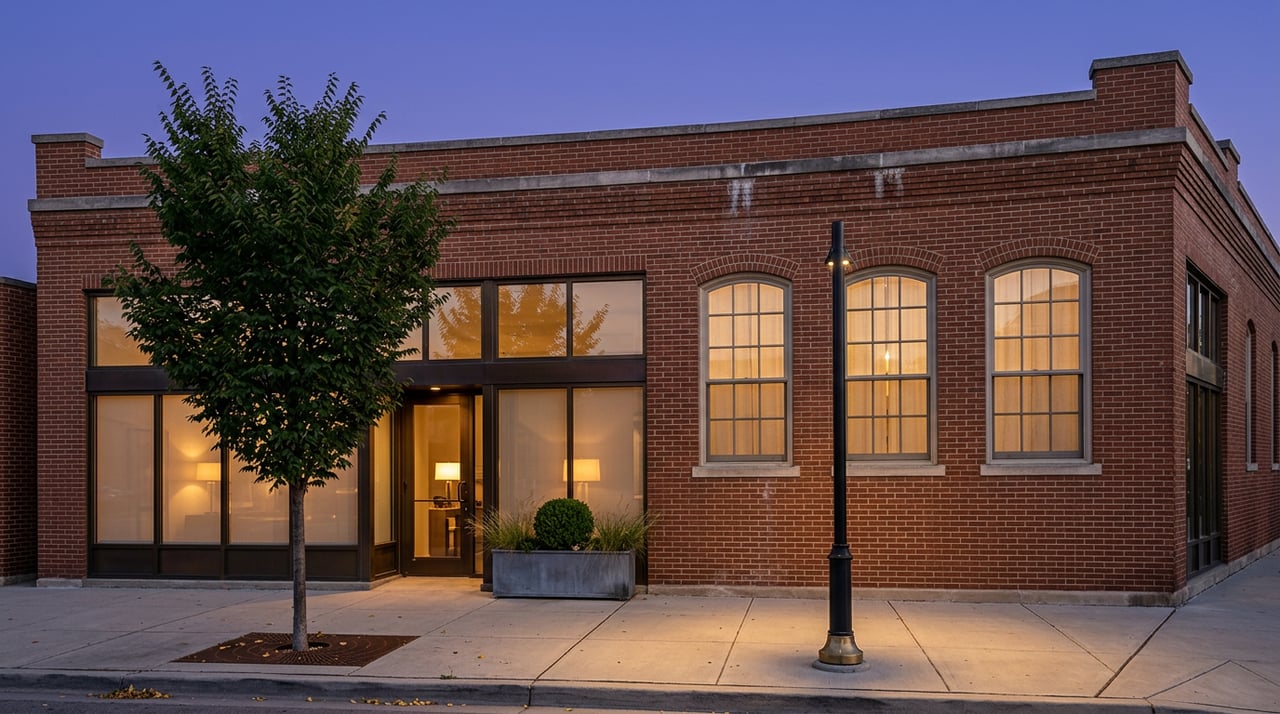
For years, the standing advice for anyone who wanted to see Franklin Street at its best was simple: come on the first Friday of the month, between five and nine, when local businesses open their doors to the public and host artists and their work. Miss that window and you got a quiet strip of storefronts, half of them dark by 7 p.m.
That advice is out of date. If you've driven Franklin Street lately, in either direction, you already know something changed. What most people haven't clocked is why the change stuck.
The street itself is the story
According to the NWI Times, in late 2024, the city reopened Franklin Street to two-way travel for the first time in more than 30 years. Mayor Angie Nelson Deuitch helped cut the ribbon, then led a convoy of municipal vehicles down the new southbound lane from Fourth Street to Ninth Street. It sounds like a paving project. It functioned like a district-wide reset.
Matt Kubik, a member of the Michigan City Public Arts Committee, had watched the district lose ground during the pandemic, when some businesses couldn't survive the lockdowns that kept people home. He wasn't shy about the gaps that left behind. A two-way street, paired with a new mayor and new energy, seemed to offer Franklin Street a reason to fill back in.
The early read-out came from the businesses that had weathered the closures. Marissa Manteo, manager of Fluid Coffee Roasters at 518 Franklin St, told the NWI Times:
Our sales were out the roof. It was amazing.
One coffee shop's best summer isn't proof of a trend. But it's the first domino, and the rest have kept falling.
What actually moved into the empty storefronts
The clearest evidence that Franklin Street's rebound is real, not just talked about, is what opened where the empty storefronts used to be.
Burn 'Em Brewing, a Michigan City brewery that's been making beer since 2013, relocated to a full-scale restaurant and taproom, describing 1215 E 2nd Street as their new home rocking a full scratch kitchen with apps, salads, sandwiches and main courses alongside a wide lineup of craft beer, seltzers, cider, wine and craft sodas. That's a few blocks off Franklin, but it put a seven-night-a-week kitchen back on the district's edge, something the corridor didn't reliably have before.
On Franklin Street proper, Cafe Farina serves Italian-American food out of a building that sat vacant before its owners spent a year on renovations to bring it back. It's the kind of restaurant that only makes sense if you're betting people will keep walking past on a Tuesday, not just a First Friday.
Recent local reviews point to a broader wave behind those two. Among the newest names showing up in Michigan City's restaurant scene: Zenzi Den, NOEMA, Rounders Pub House, Las Torres, The Greek Joynt, and Deba Sushi Bar. Not every one of those sits directly on Franklin Street, but their arrival tells you something about the appetite for new food concepts in a city that, five years ago, was still counting its empty storefronts.
The people upstairs never left
There's a piece of this that predates the traffic change and explains why the district had a floor to rebuild from in the first place. The Warren Building at 717 Franklin St, a six-story structure downtown, was refurbished into the Artspace Uptown Artist Lofts, Artspace's first project in Indiana, transforming the vacant Warren Building into an affordable live and work facility containing 44 units of housing for low-income artists and their families.
That's not a weekend crowd. That's forty-four households who wake up on Franklin Street every day, whether or not there's an event on the calendar. Those residents, plus people now living in many of the once-empty upper floors in other renovated buildings, were part of what kept the district's lights on through the years when foot traffic alone wouldn't have.
The building at 711 Franklin St is the next piece of that puzzle. Plans announced in early 2025 called for renovating the building to add ground-floor retail space and a public plaza built for concerts, festivals, and shows, the kind of infrastructure that assumes people will be around on an ordinary Tuesday, not just during a festival weekend.
What's actually on the calendar this month
None of this means the calendar stopped mattering. It means the calendar is no longer the only reason to show up. Here's what's worth knowing for August:
| Event | When | Where | Cost |
|---|---|---|---|
| Lubeznik Arts Festival (44th annual) | Aug. 15 to 16, 2026 | 101 W. 2nd St | $5 Saturday, free Sunday |
| First Friday Art Walk | First Friday of every month, 5 to 9 p.m. | Franklin Street storefronts | Free |
| Taste of Michigan City | First weekend of August annually | Franklin Street | Free entry, food priced individually |
The Lubeznik Arts Festival is the one with the most reason to plan around this year. LCA is marking its 44th Lubeznik Arts Festival on Aug. 15 and 16, and the summer exhibition on view during the festival, "Kindred Spirits," pairs Chicago sculptors Margaret Wharton and Betsy Odom, separated by nearly forty years in age yet strikingly aligned in spirit, both arriving in Chicago carrying sensibilities shaped by Southern histories of making, repair and resourcefulness. Saturday admission runs five dollars, free for LCA members, children 16 and under, and active military and veterans, while Sunday is free to everyone thanks to sponsorship from McDonald's of LaPorte County. Organizers are expecting more than 3,000 visitors over the two-day festival, with free parking and a shuttle running from Blue Chip Casino and Lighthouse Mall for anyone who'd rather not fight for a spot on 2nd Street.
The Taste of Michigan City, hosted by the Michigan City Mainstreet Association, does the same thing for the district's food scene that Lubeznik does for its art: it turns dozens of individual businesses into one shared event, bringing dozens of local restaurants to the Uptown Arts District, giving people a chance to sample the variety available around Michigan City, with musical acts and a beer garden featuring local breweries and wineries. It's traditionally held the first weekend in August, so if you missed it this year, it'll be back on the same footing next summer.
Why the calendar matters less than it used to
Here's the actual shift, and it's the one worth sitting with. A district that depends on First Fridays and festival weekends is a district that goes dark the other twenty-nine days of the month. Franklin Street doesn't do that anymore, not because the events got bigger, but because the street itself started working differently. Two-way traffic made it possible to park in front of a business instead of driving past it twice. Forty-four artist households upstairs meant there were people around on a Wednesday night. A coffee shop's best summer became a brewery's relocation became an Italian restaurant reopening a building that had sat empty. None of it was one decision. All of it depended on the street actually functioning as a street.
If you live in Long Beach, Duneland Beach, or Beverly Shores and you've been timing your Franklin Street trips around the first Friday of the month out of habit, you can stop. The habit made sense when the district ran on a monthly clock. It doesn't anymore.
We spend a lot of time in the towns along this shoreline, not just showing homes but paying attention to what's actually happening in them. If you're curious what else has shifted in the towns around the dunes, or you're thinking about a move into one of them, Heidi Picard Properties is a good place to start that conversation.